
96-Well Collection Plates
A 96-well plate is a standardized, flat plate with a grid of 96 shallow depressions or "wells" used as small test tubes. The wells are arranged in a 8×12 matrix with rows labeled A-H and columns labeled 1-12.
Key Features of Phenomenex’s 96-Well Plates
Phenomenex’s 96-well plates deliver consistent well-to-well uniformity, ensuring accurate and reproducible results for applications like LC-MS, bioanalytical testing, and routine QC.
- Durable and Chemically Resistant: Made of chemically inert polypropylene, these plates withstand demanding lab conditions while protecting sample integrity.
- Automation-Compatible: Seamlessly integrates with liquid handling systems to reduce manual errors and boost workflow efficiency.
- Versatile Design: Available in conical V-shaped and round-bottom formats, with multiple volumes to accommodate diverse sample types and preparation methods.
- Optimized for Analytical Testing: Low-extractable plates with excellent clarity for precise results and reliable visual inspection.
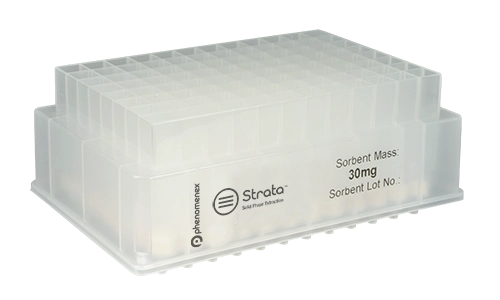
Types of 96-Well Plates: Bottoms, Well Shapes, and Volumes
96-well plates are designed in various configurations to support different laboratory workflows. Each design features bottom type, well shape, and volume that impacts performance and usability.
- Bottom Types
- Conical (V-bottom): Maximizes sample recovery; ideal for complete liquid transfer.
- Round Bottom: Best for mixing and even sample distribution.
- Well Shapes
- Square Well: Higher capacity; suited for storage and fraction collection.
- Round Well: Easier washing and efficient liquid recovery.
- Well Sizes and Volumes
- Diameter: Standardized for instrument and sealing compatibility.
- Volume Range: Options like 350 μL, 1 mL, and 2 mL for assays to large-volume collections.
These design variations allow a 96 well collection plate to fit diverse analytical and preparative workflows.
Common Uses of 96-Well Collection Plates in Sample Preparation
96 well collection plates are essential tools for high-throughput laboratories, offering efficiency and flexibility across a wide range of applications. Their design supports multiple workflows in analytical and preparative processes.
Common uses include:
- Sample collection: Efficient fraction collection in solid-phase extraction (SPE) and protein precipitation workflows.
- Sample storage: Secure short- or long-term storage of biological or chemical samples.
- Concentration and drying: Ideal for evaporative concentration and reconstitution steps.
- High-throughput workflows: Compatible with robotic systems for automated liquid handling.
- Assay preparation: Simplifies setup for enzymatic assays, PCR, or oligonucleotide purification.
These design variations allow a 96 well collection plate to fit diverse analytical and preparative workflows.
Phenomenex 96-Well Plate Portfolio
Phenomenex offers a comprehensive portfolio of 96 well plates designed for versatility and performance. Options include multiple well depths, shapes, and bottom configurations to suit diverse laboratory applications. These plates are manufactured with high-quality materials and optimized for compatibility with Phenomenex sample preparation products, ensuring seamless integration into analytical workflows. Whether for protein precipitation, SPE, or storage, Phenomenex provides reliable 96-well plate solutions tailored to research and industrial needs.
FAQs
What is the standard volume of a 96-well plate?
Standard 96-well plates typically hold between 200 µL and 2 mL per well, depending on the plate depth and design.
Are 96-well plates compatible with automated systems?
Yes, most 96 well plates are designed with SBS-standard dimensions, making them compatible with automated liquid handling systems and robotic platforms.
Can 96-well plates be reused?
While some plates may be reused with proper cleaning, single-use is generally recommended to avoid cross-contamination and ensure data reliability.
What material are 96-well plates made from?
96- well plates are commonly made from high-quality polypropylene or polystyrene, chosen for their chemical resistance and durability.
Can I autoclave the 96-well plate?
Certain polypropylene plates can be autoclaved, but it’s important to confirm material compatibility before sterilization.
Can I use 96-well plate with Protein Precipitation Plate?
Yes, 96-well collection plates are often paired with protein precipitation plates for efficient sample cleanup workflows.
Can I use it for protein or oligo samples?
Yes, these plates are widely used for protein purification, oligonucleotide isolation, and other biomolecular sample preparation workflows.