

Posted on Dec 4, 2025
Author: Mark Colbassi, MSc, Sr. Global Content Marketing Specialist
If ADC analysis feels harder than it should, you’re not alone. ADC characterization is notoriously challenging. Multiple DAR species, positional isomers, and formulation leftovers make intact MS messy. The good news? There’s a way to simplify the problem: utilizing a column created for ADC characterization that can do the heavy lifting.
The Challenge
ADCs are heterogeneous. Without chromatographic separation of DAR species and positional isomers, intact High Resolution Mass Spectrometry (HRMS) yields convoluted spectra and uneven responses. This complicates DAR calculations, slows development, and causes re-running of results.
The Native RPLC-HRMS Approach
Preserve ADC integrity during LC by limiting organic solvent strength (≤ 25% IPA) and using MS-compatible buffers. Because solvent strength is restricted to maintain native conditions, method development relies on column hydrophobicity, not mobile phase modifications.
- Cleaner Spectra: Lower charge states reduce spectral congestion, simplifying deconvolution.
- Improved Heterogeneity Insight: Chromatographic separation of DAR species minimizes overlap.
- Accurate DAR Calculations: Consistent ionization across species yields true conjugation profiles.
- HRMS Compatibility: Volatile buffers and gentle conditions protect MS systems and sample integrity.
Native RPLC follows the same general conventions as standard RPLC (gradients, temperature, column screening). You’re not reinventing LC—you’re just optimizing within a native compatible solvent ceiling.
Method Development
Now that the challenge is understood, what can be done to help solve for these issues. In order to do this, we executed a column selection study under the same Native RPLC HRMS conditions to determine which stationary phase best resolves intact ADCs across their DAR ladder without exceeding native compatible solvent strength. In other words, we tuned stationary phase hydrophobicity—not solvent—because the organic content was capped (≤ 25% IPA) to preserve the native, intact state.
Bottom line question
If we hold native friendly mobile phases and gradient constant, which column chemistry gives the right balance of retention and elution for complete, consistent, and reliable ADC characterization
Native RPLC Columns Screened (50 × 2.1 mm)
- Biozen Native RP-1 (most hydrophobic)
- Biozen Native RP-5 (moderate hydrophobicity)
- Prototype 6 (least hydrophobic)
Sample prep: Buffer exchange to 20 mM ammonium formate (pH 5.0) via 30 kDa molecular weight cut off (MWCO) centrifugal filters to remove possible formulation excipients.
Mobile phases (MS compatible, native conditions)
A: 50 mM ammonium acetate (water)
B: IPA / 50 mM ammonium acetate (50:50, v/v)
Hint: Volatile salts + restrained IPA keep conditions native and ESI friendly.
Gradient concept: Increase %B for elution while keeping IPA ≤ 25% (remember phase B is 50/50 IPA and buffer, so 50% of B equals 25% IPA) during the separation window, while keeping the flow at 0.2 mL/min, temperatures at 35 °C.
Injection volume: 100 µg
MS: ESI+, m/z 1,000–8,000, intact identification via HRMS with deconvoluted neutral masses.
Find full LC conditions and Sample Preparation methods in the poster
Results
Visual overview of the column effect
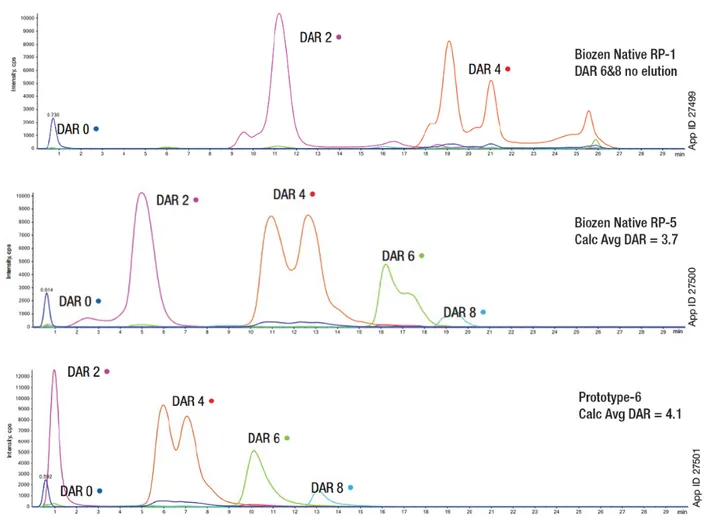
Figure 1. Native RPLC separations of Polivy® under identical native compatible conditions using three columns with increasing hydrophobicity.
Biozen™ Native RP 1 — too hydrophobic under native limits
- For Policy, DAR 6 and DAR 8 did not elute at the study’s native solvent ceiling; earlier species were retained and resolved. If your high DAR peaks don’t appear under native conditions, step down in hydrophobicity.
Prototype 6 — not enough retention
- Retention was too low; DAR 2 overlapped with DAR 0.
- If DAR 0/2 merge, step up in hydrophobicity (toward RP 5) and increase retention.
Biozen™ Native RP 5 — the practical sweet spot
- All DAR species eluted and were resolved sufficiently for HRMS identification. The study reports good mass accuracy (< 50 ppm) for deconvoluted intact masses and reproducibility across multiple tests.
- RP 5 balances retention vs. elution under native constraints, supporting full ladder DAR assignments and credible averaging.
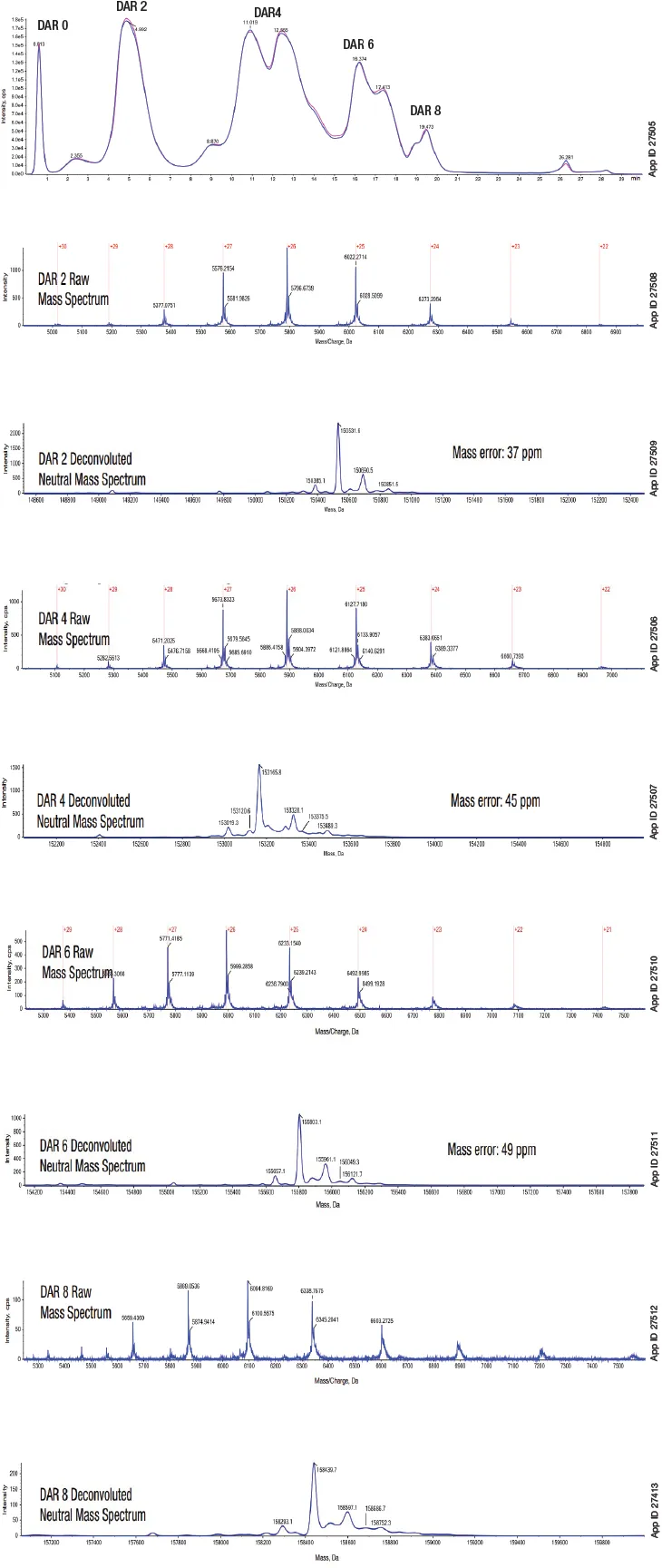
Figure 2. Polivy® on Biozen Native RP 5: extracted ion chromatograms for DAR 0/2/4A/4B/6/8 with corresponding raw and deconvoluted spectra; all species elute and are positively identified (study reports < 50 ppm mass="" error)="" and="" the="">average DAR is around 3.6.
Read the full poster to see how this was tested on different ADCs to test the method and checked with UV results. This ensures that average DAR values from HRMS matched both UV results and literature values, reinforcing the method’s accuracy and providing consistent DAR results across two detection approaches, which is critical for confidence in method reliability.
Recap: Quick Decision Guidelines
With all this considered, we can create a super short guideline for ADCs method development:
- Late-eluting DAR missing? The column is too hydrophobic.
- Early-eluting DAR unretained? The column is not hydrophobic enough.
- All species present, but crowded? You can keep the same hydrophobicity and fine-tune gradient slope/temperature (but keep in mind the native conditions of your ADC).
This study reinforces a key principle: in native RPLC HRMS for ADCs, column hydrophobicity, and not solvent strength, is the main selectivity variable to consider. By holding conditions that preserve native structures constant and screening columns logically, the authors show a practical path to full DAR coverage without denaturation. Biozen™ Native RP 5 emerged as the balanced choice here, but the bigger insight is methodological: this approach could serve as a platform strategy, with the caveat that future work should test its robustness across diverse ADC.
FAQs
What does “DAR” mean, and why is it important in ADC analysis?
DAR (Drug-to-Antibody Ratio) is the average number of drug molecules attached to one antibody in an Antibody–Drug Conjugate (ADC). It determines how potent, stable, and safe the ADC is. Accurate DAR measurement through native RPLC–HRMS ensures consistent conjugation levels across manufacturing batches and reliable therapeutic performance.
Why is chromatographic separation critical before mass spectrometry?
If DAR species aren’t separated before MS, the resulting spectra become highly complex with overlapping charge states and signals. Native RPLC resolves these species first, simplifying spectra, improving ionization consistency, and allowing precise and reproducible DAR quantification, without compromising ADCs' functional integrity.
What defines a “native” RPLC method for ADCs?
A native RPLC method maintains the ADC’s intact, folded conformation during LC–MS analysis. This is achieved by limiting organic solvent strength (≤ ~25 % IPA) and using volatile, MS-compatible buffers such as ammonium acetate. These gentle conditions preserve the antibody’s native state while still separating species based on hydrophobicity.
How does column hydrophobicity influence ADC separation in native RPLC?
Since solvent strength is restricted, column hydrophobicity becomes the main variable controlling selectivity.
- Too hydrophobic (e.g., RP-1): high-DAR species may not elute.
- Too weak (e.g., Prototype-6): low-DAR species coelute.
- Balanced hydrophobicity (e.g., RP-5): all DAR species elute cleanly, enabling accurate characterization under native conditions.
How does native RPLC separate DAR species that differ by only a few drugs?
Each attached drug payload is very hydrophobic, so even one or two additions alter the ADC’s overall surface properties. In reversed-phase LC, more hydrophobic species interact more strongly with the stationary phase and elute later. This creates a clear hydrophobicity-based “DAR ladder”, DAR 0 first, then 2, 4, 6, and 8, even though mass differences are small.